
Cloud services have become an integral part of digital services within every major industry, encompassing several different ways to store data. Hybrid cloud technologies present the benefit of storage in both private and public clouds for agile business performance.
How do Hybrid Cloud Services Work?
A hybrid cloud model utilizes both public and private clouds and communicates data between the two. What defines a ‘hybrid’ is at least one public cloud, and at least one private cloud, however, the number of each can vary depending uponcapacity.
While public clouds typically exist offsite, private clouds operate onsite. Access to both allows a business to easily move and scale any private cloud overflow to a public cloud, adapting tocurrent demand. This process is made complete with the help of providers like AWS, Microsoft Azure, Google Cloud Services and IBM.Businesses have full control over their computing power without having to rely on third party data centers, keeping sensitive data on-premises and storing the rest in public cloud, therefore enhancing security.This model ultimately creates a more flexible digital computing strategy where necessary.
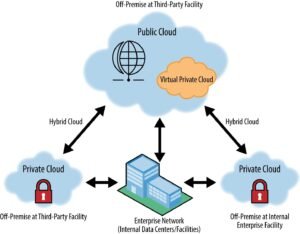
(Source: CRM Trilogix)
Many refer to this framework as “the best of both worlds”. Instead of investing in full program installation and maintenance for data storage, companies will only have to spend on temporary and local resources when they experience rises in demand or when dealing with sensitive data.
How can a Hybrid Cloud Infrastructure Benefit your Company?
Productivity & Speed
The unification of private and public clouds presents significant benefits. With more power and control over your data and where it goes,your development teams gain a simplified process when deploying information to various clouds. A hybrid cloud will also help you save time with onsite infrastructure with the ability to migrate all your applications at a much quicker pace.What does this mean? Faster development cycles, faster service delivery, and faster responses to clients. A strong grip on internal operations leads to a better client experience.
Compliance & Security
With all your clouds synchronized, the most substantial cloud security technologies become available to you. These technologies also aid in compliance and provide consistent and reliable security measuresacross your company’s entire digital infrastructure.
Cost Saving
As mentioned above, the investment and pay-as-you-go model for temporary resources when required takes a huge expense load off your shoulders.Hybrid cloud gives you more power and option for where and when your funds go.
If the benefits of a hybrid infrastructure seem to align with your business objectives, contact us to learn more. Trinus has all the partnerships and experience necessary to assist with your digital needs, from AWS to Azure to IBM.